Can GBS Screening Be Both Fast and Accurate?
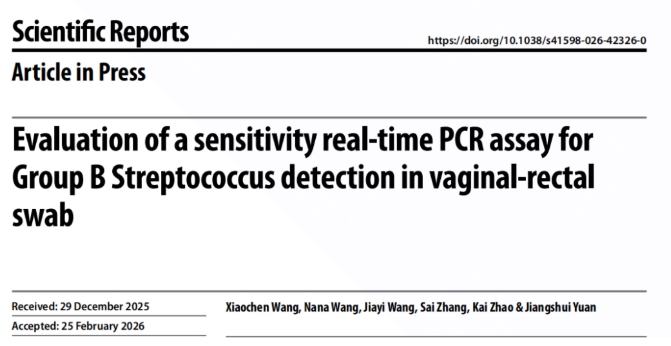
A recent Scientific Reports study highlights how molecular diagnostics are helping improve prenatal GBS screening.
Every expectant parent hopes for a healthy start—but timely diagnosis can make all the difference. Group B Streptococcus (#GBS) is one of the leading causes of invasive neonatal infections worldwide. Although routine screening during late pregnancy has become standard practice in many countries, conventional culture methods often require up to three days before results are available. In urgent obstetric situations, that delay can affect clinical decision-making. Could molecular diagnostics provide a faster alternative without compromising accuracy? A recent study published in Scientific Reports suggests the answer may be yes.
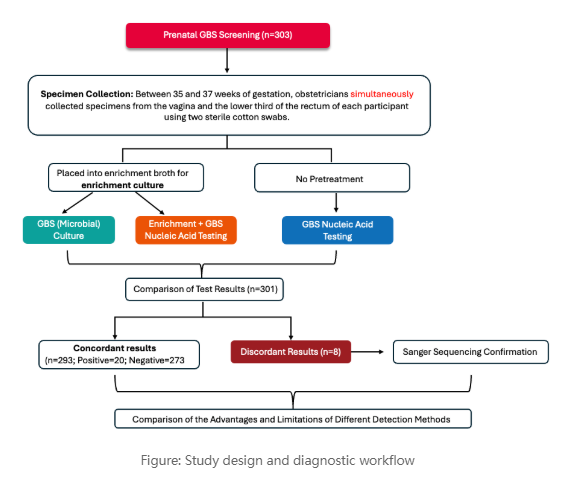
Researchers evaluated the clinical performance of the #Sansure Group B Streptococcus Nucleic Acid Detection Kit (PCR-Fluorescent Probe Method) using vaginal–rectal swab samples collected from pregnant women between 35 and 37 weeks of gestation.
Unlike conventional culture, the assay enables direct real-time PCR without requiring an enrichment step, enabling a standardized workflow supported by the Natch 96 Automated Nucleic Acid Extraction System and mainstream real-time PCR platforms. The study assessed whether this simplified workflow could maintain diagnostic accuracy while improving turnaround time.
Key Findings:High sensitivity without enrichment.
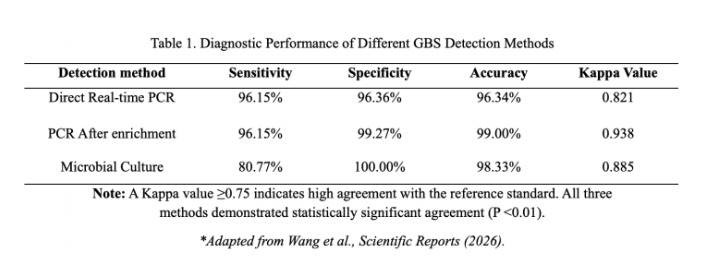
One of the most notable findings was that direct real-time PCR achieved a sensitivity of 96.15%, matching PCR performed after enrichment while eliminating the enrichment step.
Compared with conventional microbial culture:
- ✅ Direct real-time PCR achieved 96.15% sensitivity, missing only one positive case.
- ✅ PCR after enrichment maintained the same sensitivity while improving specificity to 27%.
- ✅ Conventional culture demonstrated perfect specificity but a substantially lower sensitivity (77%), missing five positive cases.
Why does this matter in clinical practice?
This simplified workflow has practical implications beyond the laboratory.
- Faster turnaround for urgent obstetric situations, including imminent delivery, preterm labor, and premature rupture of membranes (PROM).
- More efficient routine prenatal screening by eliminating the enrichment step.
Streamlined laboratory workflows without sacrificing diagnostic performance.
Current recommendations from the CDC, ACOG, and the Chinese Society of Obstetrics and Gynecology already recognize nucleic acid amplification tests (NAATs) as valuable tools for GBS screening.
The findings from this study add further evidence supporting molecular diagnostics as a reliable approach for prenatal GBS screening—particularly in clinical scenarios where rapid turnaround is critical.
As molecular testing continues to evolve, integrating speed, accuracy, and workflow efficiency will become increasingly important in improving maternal and neonatal care.
References
Wang X, Wang N, Wang J, Zhang S, Zhao K, Yuan J. Evaluation of a sensitive real-time PCR assay for Group B Streptococcus detection in vaginal-rectal swab[J]. Sci Rep. 2026 Mar 2;16(1):11582. doi: 10.1038/s41598-026-42326-0.