From ER to Primary Care: How Molecular Point-of-Care Testing Is Reshaping Tiered Diagnosis of Respiratory Infections?
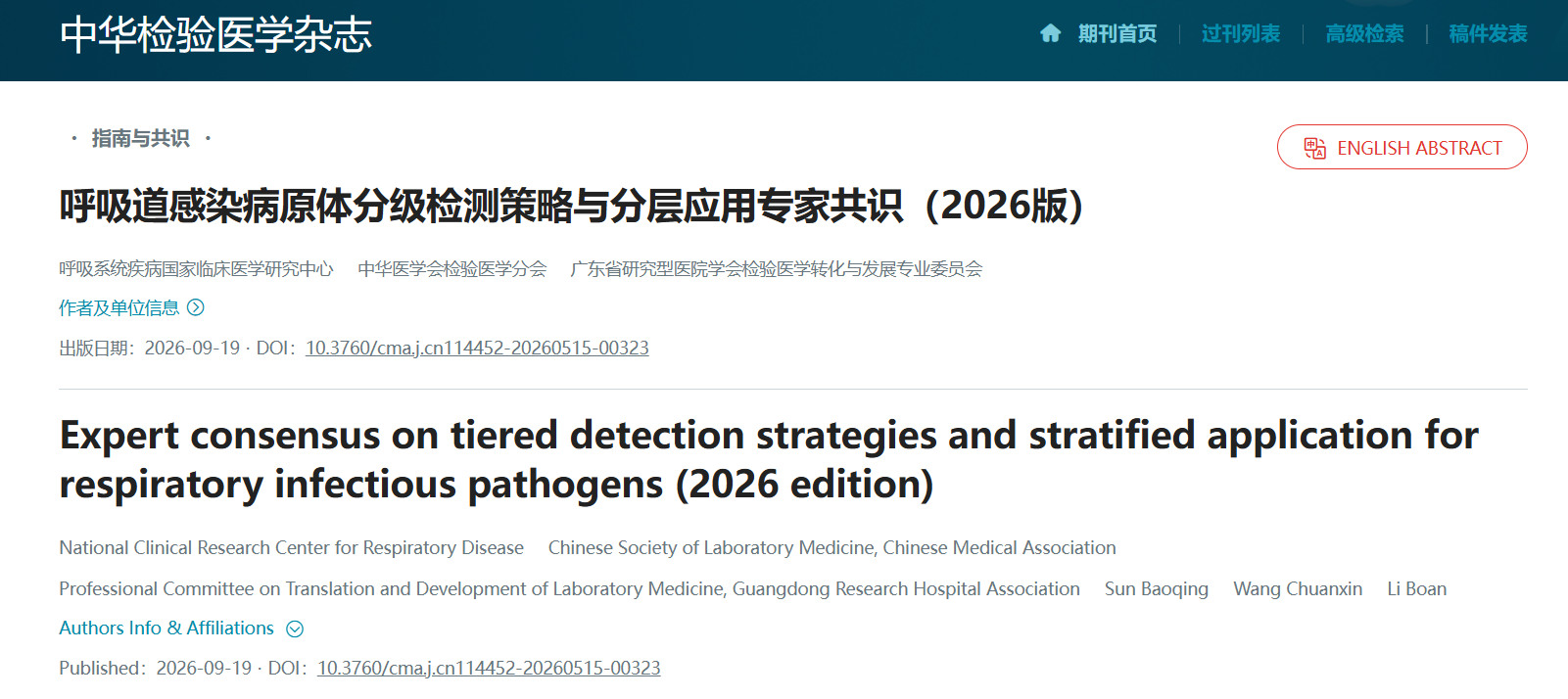
Recently, the Expert Consensus on Graded Testing Strategies and Tiered Application of Respiratory Pathogens (2026 Edition) [1] was officially published in the Chinese Journal of Laboratory Medicine. Led by the National Clinical Research Center for Respiratory Diseases and the Chinese Society of Laboratory Medicine, the consensus was developed by a multidisciplinary expert panel and puts forward 17 recommendations on the graded testing strategies and tiered application of respiratory pathogen testing. One of the key highlights is the explicit inclusion of molecular point-of-care testing (POCT) as a first-line option in scenarios where rapid turnaround time (TAT) is critical.
In the same issue, an expert commentary, Advancing Multidimensional Technological Innovation to Optimize Precision Diagnosis of Respiratory Infections [2], further discussed how molecular testing can be moved closer to the point of care and expanded into primary healthcare settings. Drawing on the consensus and related research evidence, this article provides a focused interpretation of the clinical positioning and value of molecular POCT within this consensus.

The consensus establishes a tiered pathogen testing pathway built on conventional microbiological testing, with nucleic acid amplification testing (NAAT) as a core component. Three recommendations specifically define the role of molecular POCT across three major scenarios: time-critical clinical care, primary healthcare triage, and outpatient/emergency decision-making.
Time-critical clinical care
Recommendation 5 states that in fever clinics, emergency departments, intensive care units (ICUs), and other settings where rapid TAT is essential, nucleic acid POCT or rapid integrated molecular testing should be prioritized for deployment, so as to achieve rapid pathogen diagnosis and support early, critical medical decisions (level of evidence: high; strength of recommendation: strong).
From the perspective of technical parameters, the consensus specifies that closed, integrated rapid-testing platforms—namely nucleic acid POCT—have a testing turnaround of approximately 15–60 minutes. Featuring simple operation and the ability to be deployed directly in clinical departments and at the bedside, these platforms meet the core need for rapid results in emergency departments, ICUs, and similar settings.
Primary care triage settings
Recommendation 9 states that primary healthcare institutions should be equipped to perform basic tests such as a complete blood count (CBC) and C-reactive protein (CRP), together with antigen screening; those with the necessary conditions may perform nucleic acid POCT to support triage decisions. Secondary hospitals should routinely perform traditional microbiological testing, molecular testing, and procalcitonin (PCT) monitoring, and should standardize the submission of pathogen testing before initiating empirical anti-infective therapy. Tertiary hospitals should establish comprehensive testing platforms covering multiplex PCR, high-throughput molecular diagnostics, identification of difficult-to-diagnose pathogens, and host immune assessment; conduct multidisciplinary team (MDT) meetings on a routine basis; and serve as a regional technical anchor. Institutions at all levels should, in light of their functional positioning, payment models, and policies on the mutual recognition of results, rationally define their testing menus on an indication-driven basis, so as to avoid the indiscriminate deployment of high-end platforms and the redundant duplication of test items (level of evidence: low; strength of recommendation: strong).
This recommendation clarifies that qualified primary care institutions may perform nucleic acid POCT to support triage decisions, providing a consensus basis for the standardized application of molecular POCT at the primary care level.
Influenza-like illness in outpatient and emergency settings
Recommendation 10 states that for outpatients and emergency department patients with influenza-like illness (ILI) during the epidemic season, in whom test results will directly affect decisions on triage, isolation, or early pathogen-directed treatment, nucleic acid POCT or antigen testing targeting core circulating pathogens should be prioritized. For immunocompetent general outpatients without a clear history of epidemiological exposure, routine broad-spectrum multi-pathogen panel testing is not recommended. For older adults (≥65 years), high-risk children, and individuals with underlying conditions or immunocompromise, the indications for multiplex PCR and similar tests may be appropriately broadened according to epidemiological and clinical circumstances (level of evidence: low; strength of recommendation: conditional).
This recommendation takes “whether immediate management will be affected” as its core criterion, defining the populations for whom nucleic acid POCT is appropriate in outpatient and emergency settings. It affirms the value of rapid diagnosis while also emphasizing the avoidance of excessive testing, consistent with the principles of health economics.
Overall, the three recommendations—approached from the perspectives of different tiers of healthcare institutions and different clinical scenarios—place nucleic acid POCT at the core of the tiered testing pathway, providing authoritative laboratory-side evidence for its standardized clinical application.

The expert commentary published in the same journal and the same issue as this consensus further elaborates, from a technological perspective, on the implementation pathway and future direction of molecular POCT [2].
The commentary explicitly states that molecular POCT is the core technology enabling rapid pathogen nucleic acid testing to move closer to clinical settings and the primary care level. Regarding deployment barriers, the Expert Consensus on the Standardized Clinical Laboratory Application of Rapid Pathogen Nucleic Acid Testing (2025 Edition) [3] has clarified that, once the absence of cross-contamination and the risk of residual amplification products is confirmed, rapid testing can be set up in conventional laboratories without the need for multi-zone physical separation. Fully closed testing requires no opening of the cap at any point in the process and no biosafety cabinet, substantially lowering the deployment threshold in clinical and primary care settings. The consensus also identifies “completing the entire testing workflow within 40 minutes” as a key technical feature of rapid nucleic acid testing.
In terms of clinical value, the commentary notes that molecular POCT enables “embedding from the laboratory into the clinical decision-making chain.” Used as a first-line screening tool in outpatient and emergency departments, general wards, and ICUs, it rapidly identifies pathogens, reduces unnecessary antibiotic prescriptions, and shortens observation time. Primary care personnel without a laboratory background can perform testing correctly after short-term training, which helps to alleviate the shortage of professional laboratory personnel at the primary care level.
In addition, the commentary highlights the supporting role of AI technology: the application of AI in amplification signal interpretation, operational compliance quality control, disease severity stratification, and anti-infective decision support provides the technological foundation for the large-scale adoption of “POCT + AI,” aligning closely with the trend toward intelligent molecular testing.

Beyond the graded testing consensus in the field of laboratory medicine, the Expert Consensus on the Diagnosis, Treatment, and Prevention of Acute Respiratory Infections in Pediatric Outpatient and Emergency Settings [4] echoes this from the perspective of clinical care. Developed by the National Institute of Hospital Administration of the National Health Commission, together with the Editorial Board of the Chinese Journal of Practical Pediatrics and the China Medical and Health Culture Association, through a multidisciplinary expert panel, the consensus states clearly in Recommendations 6 and 7 state clearly: for laboratory confirmation of viral infection, nucleic acid testing is the preferred first-line choice, with rapid POCT prioritized; when testing capacity is insufficient, antigen testing may be used as an alternative. The consensus also recommends that laboratory confirmation of atypical pathogen infection rely primarily on nucleic acid testing.
At this point, the two consensus documents—one from the laboratory side and one from the clinical side—complement each other across the two dimensions of testing strategy stratification and clinical practice, jointly identifying nucleic acid POCT as the preferred technical pathway for the rapid identification of respiratory pathogens. This recommendation is based not only on the advantage of rapid turnaround, but also on accumulating evidence of clinical benefit. A meta-analysis of 25 randomized controlled trials involving 12,638 participants (39% of whom were children) showed that molecular POCT reduced antibiotic use by 21% in the pediatric subgroup (RR = 0.79, 95% CI 0.65–0.97) [5]. These findings were adopted by the pediatric consensus as evidence-based support, providing direct data backing for the clinical value of nucleic acid POCT. The dual benefits of rapid identification and rational medication use are driving nucleic acid POCT from consensus recommendation into clinical practice.

The recommendations of the consensus and the commentary are supported by multiple high-quality randomized controlled trials (RCTs) and international guidelines.
Emergency and critical care settings
The UK ResPOC randomized controlled trial, which enrolled 720 adults with acute respiratory illness, showed that although routine molecular POCT did not significantly reduce the overall proportion of antibiotic use, it shortened mean hospital stay by approximately one day (5.7 vs 6.8 days), and more patients received short-course or single-dose antibiotic therapy (17% vs 9%, p = 0.0047), with more guideline-concordant influenza antiviral treatment (91% vs 65%) [6]. A Danish multicenter RCT involving 294 patients acutely admitted with suspected community-acquired pneumonia further showed that after the introduction of POC-PCR, antibiotic prescriptions within 4 hours and 48 hours of emergency admission matched the detected pathogens more precisely (4h OR 5.68; 48h OR 4.20), and that prescriptions at 48 hours and on day 5 better met guideline appropriateness requirements (48h OR 2.11; day 5 OR 1.40) [7].
Guidance issued in 2020 by the Diagnostics Committee of the Infectious Diseases Society of America (IDSA) notes that in the emergency department, molecular testing delivers its greatest clinical benefit only when results are returned rapidly [8], which mutually corroborates, at the evidence level, the short TAT characteristic of nucleic acid POCT.
Primary care settings
In China, the antibiotic prescribing rate for acute upper respiratory infections at the primary care level remains high [9]. A large cluster-randomized controlled trial conducted in rural primary care settings showed that comprehensive measures combining evidence-based guidelines with AI-driven prompts reduced the antibiotic prescribing rate from 71% to 26%, without increasing the 30-day hospitalization risk [10]. This real-world evidence indicates that AI-assisted decision-making can effectively improve anti-infective prescribing behavior at the primary care level. The synergy between molecular POCT and AI is moving this capability upstream, from “medication decisions” to “pathogen diagnosis.” As the commentary notes, combining molecular POCT with AI technology reduces dependence on laboratory space and specialized personnel, enabling primary care institutions to complete standardized pathogen testing at the first point of contact. This helps to compensate for the insufficient pathogen identification capacity at the primary care level and provides practical support for the implementation of tiered diagnosis and treatment.
From the graded testing consensus on the laboratory side, to the pediatric care consensus on the clinical side, and to the accompanying commentary on the technological pathway, the value of molecular POCT in emergency departments, ICUs, fever clinics, and primary care has formed a complete support system spanning “consensus recommendations, technological pathways, and evidence-based validation.” For the precision diagnosis of respiratory infections, molecular POCT has evolved from a supplementary rapid test into an important solution for time-critical, high-triage scenarios.
As the consensus is implemented and disseminated, molecular POCT is expected to deliver value across more clinical scenarios, helping to make the diagnosis and treatment of respiratory infections more standardized and more precise.
References
- National Clinical Research Center for Respiratory Diseases; Chinese Society of Laboratory Medicine; Professional Committee of Laboratory Medicine Translation and Development, Guangdong Research Hospital Association.Expert consensus on graded testing strategies and tiered application of respiratory pathogens (2026 edition)[J]. Chinese Journal of Laboratory Medicine, 2026, 49(9): 1069-1082.
- Yang G, Shan Y, Wu Y, et al. Advancing multidimensional technological innovation to optimize precision diagnosis of respiratory infections[J]. Chinese Journal of Laboratory Medicine, 2026, 49(9): 1039-1044.
- Genetic Testing Branch, China Association of Medical Equipment; National Clinical Research Center for Laboratory Medicine; Beijing Center for Medical Laboratory Quality Control and Improvement. Expert consensus on the standardized clinical laboratory application of rapid pathogen nucleic acid testing (2025 edition)[J]. National Medical Journal of China, 2025, 105(24): 1968-1973.
- National Institute of Hospital Administration, National Health Commission; Editorial Board of the Chinese Journal of Practical Pediatrics. Expert consensus on the diagnosis, treatment, and prevention of acute respiratory infections in pediatric outpatient and emergency settings[J]. Chinese Journal of Practical Pediatrics, 2026, 41(6): 442-459.
- Li Q, Zhou Q, Fan J, et al. Impact of molecular point-of-care testing for respiratory pathogens on antibiotic use and clinical outcomes in acute respiratory tract infections: a systematic review and meta-analysis[J]. eClinicalMedicine, 2026, 92: 103799.
- Brendish NJ, Malachira AK, Armstrong L, et al. Routine molecular point-of-care testing for respiratory viruses in adults presenting to hospital with acute respiratory illness (ResPOC): a pragmatic, open-label, randomised controlled trial[J]. Lancet Respir Med, 2017, 5(5): 401-411.
- Cartuliares MB, Rosenvinge FS, Mogensen CB, et al. Evaluation of point-of-care multiplex polymerase chain reaction in guiding antibiotic treatment of patients acutely admitted with suspected community-acquired pneumonia in Denmark: a multicentre randomised controlled trial[J]. PLoS Med, 2023, 20(11): e1004314.
- Hanson KE, Azar MM, Banerjee R, et al. Molecular testing for acute respiratory tract infections: clinical and diagnostic recommendations from the IDSA’s Diagnostics Committee[J]. Clin Infect Dis, 2020, 71(10): 2744-2751.
- Fu M, Gong Z, Li C, et al. Appropriate use of antibiotics for acute respiratory infections at primary healthcare facilities in China: a nationwide cross-sectional study from 2017 to 2019[J]. Lancet Reg Health West Pac, 2023, 40: 100880.
- Wei X, Zhuo C, Hicks JP, et al. Effects of a comprehensive antibiotic stewardship program on antibiotic prescribing for acute respiratory infections in rural facilities: a cluster randomized trial[J]. Nat Med, 2026, 32(3): 841-848.