
Pre-sepsis Stage: Opening a New Avenue for Early Sepsis Detection
Sepsis is a life-threatening condition caused by infection-induced immune dysregulation, leading to organ dysfunction and high mortality.
Although the Sepsis-3 criteria use SOFA-based organ dysfunction as the diagnostic standard, waiting until organ damage occurs may miss the optimal intervention window, contributing to millions of deaths worldwide each year. The concept of pre-sepsis(early sepsis) has emerged as a critical stage after infection onset, where immune imbalance occurs before irreversible organ injury.
Understanding immune changes and developing early molecular warning tools are essential for improving sepsis outcomes.

Sepsis diagnostic criteria have evolved through three major stages, but limitations remain in early warning and pre-emptive identification.
Sepsis-1 (1991): Based on SIRS criteria, but with broad thresholds and low specificity, leading to potential overdiagnosis.
Added more organ function parameters to improve assessment, but still could not distinguish common inflammation from life-threatening infection.
Sepsis-2 (2001): Added more organ function parameters to improve assessment, but still could not distinguish common inflammation from life-threatening infection.
Sepsis-3 (2016): Defined sepsis as “life-threatening organ dysfunction caused by a dysregulated host response to infection”, using infection plus SOFA score ≥2 as the diagnostic standard. This improved diagnostic accuracy but remains limited for early screening and intervention before organ dysfunction occurs.
However, Sepsis-3 remains limited in early warning and pre-emptive screening, resulting in missed opportunities for timely intervention.
Delayed Intervention Window
Sepsis treatment requires rapid intervention. Studies show that each hour of delay in treating septic shock increases mortality risk by approximately 10%.
SOFA score elevation and organ dysfunction represent late consequences of immune dysregulation. By the time these clinical signs appear, irreversible processes such as endothelial injury, immune paralysis, and microthrombosis may already have developed.
Neglect of Individual Immune Heterogeneity
Immune responses vary greatly among individuals. Vulnerable populations, including elderly patients, cancer patients, transplant recipients, and long-term immunosuppressant users, often show impaired immunity and faster disease progression with subtle early symptoms.
Traditional biomarkers such as CRP and PCT may have limited sensitivity or specificity in early occult infections. Therefore, a uniform SOFA-based diagnostic approach may fail to detect early immune dysregulation, resulting in delayed diagnosis and intervention.

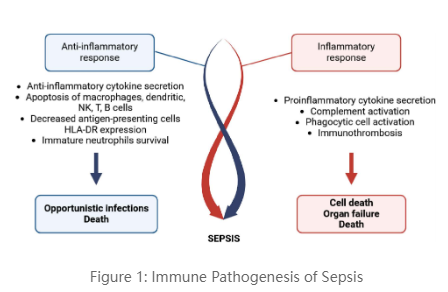
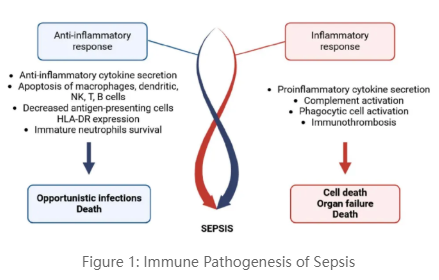
Pathogens, including bacteria, viruses, and fungi, trigger complex immune responses after entering the host, leading to sepsis progression. (Figure 1)
Pro-inflammatory Pathway Activation
TLRs recognize pathogen-associated molecular patterns (PAMPs), activating innate immunity and releasing inflammatory mediators. Excessive activation causes immune cell overactivation, endothelial dysfunction, and immunothrombosis, which may progress to DIC, organ dysfunction, and death.
Compensatory Anti-inflammatory Response / Immunoparalysis Pathway
Meanwhile, the immune system activates suppressive pathways. Immune cell apoptosis, reduced monocyte antigen presentation, IL-10 release from immature neutrophils, and regulatory T-cell activation drive an immunosuppressive state. This increases susceptibility to secondary infections and contributes to late-stage sepsis mortality.
Oxidative Stress and Nitric Oxide-Mediated Damage
Excessive production of reactive oxygen species (ROS) and reactive nitrogen species (RNS) aggravates cellular injury. Increased nitric oxide (NO) production further contributes to mitochondrial dysfunction. Sepsis results from an imbalance between excessive inflammation and immune suppression, leading to systemic immune dysregulation and organ failure. The timing and interaction between inflammatory activation and immune suppression during sepsis progression remain under investigation.

Pre-sepsis is a critical transitional stage after pathogen invasion, where immune dysregulation has occurred but organ dysfunction has not yet developed.
The Mechanism of Immune Dysregulation
Sepsis involves an imbalance between pro-inflammatory activation and anti-inflammatory suppression. During pre-sepsis, both pathways are activated simultaneously:
Pro-inflammatory Phase: Pathogens activate innate immunity through TLRs, inducing the release of cytokines such as TNF-α and IL-6. This promotes immunothrombosis, endothelial injury, and systemic inflammation.
Anti-inflammatory Phase: The body simultaneously initiates compensatory immune suppression. Increased levels of anti-inflammatory mediators such as IL-10, together with apoptosis of immune cells including T cells, B cells, and dendritic cells, reduced antigen-presenting capacity, and decreased HLA-DR expression, contribute to immune paralysis and increased susceptibility to secondary infections.
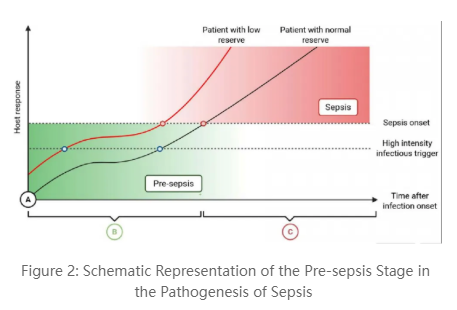
The Golden Window for Intervention: From Homeostasis to Decompensation
Sepsis progression is driven by the imbalance between pro-inflammatory activation and anti-inflammatory suppression. The interaction between these immune responses determines whether the host maintains stability or progresses to severe sepsis. The disease progression can be divided into three stages:
Stage A (Infection Trigger): Pathogen invasion occurs and initiates the early immune response.
Stage B (Pre-sepsis): Immune dysregulation emerges, but organ function remains relatively stable. This stage represents the “golden window” for intervention, where early detection and treatment may prevent disease progression.
Stage C (Sepsis): Compensatory mechanisms become exhausted, the disease crosses the critical threshold, and irreversible organ dysfunction develops.
Key Insight:During the pre-sepsis stage, molecular signals of immune dysregulation may already be present, while conventional clinical signs and routine laboratory markers remain normal. This gap between early biological changes and delayed clinical recognition is a major reason why current diagnostic approaches often miss the optimal intervention window.

Based on the concept of pre-sepsis, two emerging clinical strategies are being developed:
Precision Medicine Based on Individual Immune Profiles
The concept of sepsis endotypes classifies patients into molecular subtypes by integrating genomic, proteomic, and clinical data, enabling personalised treatment strategies.
Prognostic stratification: Patients with hyperinflammatory phenotypes may benefit from immunosuppressive therapies, while immunosuppressive phenotypes may require immune-enhancing approaches.
Therapeutic challenges: Dynamic monitoring is essential because an individual patient’s immune phenotype may change throughout disease progression.
Single biomarkers cannot fully capture the complex immune dynamics of sepsis. Advanced approaches, including transcriptomic profiling and multi-gene panels, provide earlier detection of immune dysregulation and support risk prediction and clinical decision-making.

The development of sepsis biomarkers reflects a shift from detecting inflammation to understanding complex immune responses.
First Generation: Limitations of Protein Biomarkers
Markers such as CRP and PCT mainly reflect downstream inflammatory responses. Their elevation often occurs after immune activation has already progressed, limiting their ability to identify the pre-sepsis stage, especially in immunosuppressed patients.
Second Generation: Functional Immune Biomarkers
Markers including IL-6, TNF-α, monocyte HLA-DR, and neutrophil CD64 provide more direct insights into immune status. However, single biomarkers cannot fully capture the dynamic immune changes during sepsis progression.
Third Generation: Transcriptomic Multi-gene Host Response Detection
Host mRNA-based multi-gene testing detects early immune dysregulation signals at the transcriptional level, enabling comprehensive immune profiling and dynamic monitoring. Compared with traditional biomarkers, this approach provides an earlier warning window and supports improved clinical outcomes. This represents a transition from single biomarker detection to integrated immune profiling and precision intervention.

SepSMART identifies pre-sepsis risk through host-response mRNA profiling, enabling early warning before clinical deterioration.
Early Signal Detection
- Detects immune dysregulation signals through host mRNA expression.
- Provides earlier warning compared with conventional biomarkers.
Clinical Validation
- Demonstrates strong performance in identifying pre-sepsis (AUC = 0.89).
- Outperforms traditional SOFA scoring and single biomarkers.
Risk screening at admission:Identify high-risk patients (elderly, cancer, transplant, immunosuppressed patients) for early intervention.
Dynamic ICU monitoring:Track host immune changes to support treatment adjustment.
Differentiation of infectious and non-infectious SIRS:Assist in distinguishing infection-related inflammation and optimizing antibiotic use.
SepSMART provides a molecular approach for early sepsis risk identification and precision management.

The concept of pre-sepsis represents a paradigm shift in sepsis management, moving from “treating severe disease” toward “preventing disease progression.”
By shifting the intervention window earlier to the pre-sepsis stage and integrating multi-omics approaches and artificial intelligence technologies, precision intervention in critical care is becoming possible. In the future, sepsis management will evolve toward a new model based on active screening, precise stratification, and real-time monitoring, transforming the way severe disease is diagnosed and managed.
Article Reference:
- Gerard R, Dewitte A, Gross F, Pradeu T, Lemoine M, Goret J, Mamani-Matsuda M. Is “pre-sepsis” the new sepsis? A narrative review. PLoS Pathog. 2025 Jul 31;21(7):e1013372.